Trigonometry unveils relationships between angles and sides of triangles, crucial for diverse fields. A 0 to 360-degree trig table, often available as a PDF, provides sine, cosine, and tangent values for every degree, aiding calculations and problem-solving.
What are Trigonometric Values?
Trigonometric values represent the ratios of sides in a right-angled triangle concerning a specific angle. These values – sine, cosine, and tangent – are fundamental to understanding periodic phenomena and geometric relationships. A trig values table, spanning 0 to 360 degrees, systematically lists these ratios for each angle, offering a quick reference for calculations.
These values aren’t arbitrary; they stem from the unit circle, where an angle’s cosine is the x-coordinate, and sine is the y-coordinate. Tangent is then sine divided by cosine. A comprehensive PDF version of such a table is invaluable for students, engineers, and anyone working with angles and triangles. Understanding these values allows for solving triangles, modeling waves, and navigating complex systems. The table facilitates quick lookups, eliminating the need for constant calculator use, especially during exams or fieldwork. Accessing a readily available PDF ensures consistent and accurate data.
The Importance of a 0 to 360 Degree Table
A 0 to 360-degree trigonometric table is essential because it covers a complete rotation in a coordinate plane, representing all possible angles. This full-circle coverage is vital for modeling cyclical phenomena like waves, seasonal changes, and rotational motion. Having values readily available, often in a convenient PDF format, streamlines calculations and avoids repetitive computations.
Unlike tables limited to 0-90 degrees, a 360-degree table accounts for all quadrants, showcasing how trigonometric functions change signs. This is crucial for solving equations and understanding function behavior. A downloadable PDF provides a portable and reliable resource for students, engineers, and physicists. It’s particularly useful when dealing with angles beyond the first quadrant, where understanding sign conventions is paramount. The table’s comprehensive nature ensures accuracy and efficiency in various applications, making it an indispensable tool for anyone working with trigonometry.
Understanding Radians vs. Degrees
While a 0 to 360-degree trig table (PDF) is incredibly useful for initial understanding, it’s vital to grasp the concept of radians. Degrees measure angles based on a circle divided into 360 parts, while radians relate angles to the radius of the circle. One complete rotation equals 2π radians, meaning 360 degrees is equivalent to 2π radians.
Many advanced mathematical contexts, particularly in calculus and higher-level physics, favor radians due to their simplification of formulas. Converting between degrees and radians is straightforward: radians = degrees * (π/180). Though a PDF table typically displays degree values, understanding the radian equivalent is crucial for broader mathematical proficiency. Familiarity with both systems allows for seamless transitions and avoids confusion. Mastering both degree-based tables and radian concepts unlocks a deeper understanding of trigonometric functions and their applications.

Core Trigonometric Functions
Sine, cosine, and tangent are fundamental. A 0 to 360-degree trig table (PDF) showcases these functions’ values for each angle, essential for solving triangles and modeling periodic phenomena.
Sine (sin θ) ⎯ Definition and Range
Sine (sin θ), in a right-angled triangle, is defined as the ratio of the length of the opposite side to the hypotenuse. Extending this to the unit circle, sine represents the y-coordinate of a point on the circle corresponding to angle θ.
The range of the sine function is between -1 and 1, inclusive: -1 ≤ sin θ ≤ 1. This means the sine value will always fall within this interval, regardless of the angle’s magnitude. A comprehensive 0 to 360-degree trig table, often found as a PDF resource, clearly illustrates these values.
Within the table, you’ll observe positive sine values in the first and second quadrants (0° to 180°), reaching a maximum of 1 at 90°. Sine becomes negative in the third and fourth quadrants (180° to 360°). Understanding these quadrant-specific behaviors, readily available in a detailed table, is crucial for accurate trigonometric calculations and interpretations. The PDF format allows for easy access and reference during problem-solving.
Cosine (cos θ) ⎯ Definition and Range
Cosine (cos θ) is defined as the ratio of the adjacent side to the hypotenuse in a right-angled triangle. When viewed through the lens of the unit circle, cosine corresponds to the x-coordinate of the point associated with angle θ. This geometric interpretation is fundamental to understanding its behavior.
The range of the cosine function is also between -1 and 1, inclusive: -1 ≤ cos θ ≤ 1. Like sine, cosine values are always contained within this interval. A detailed 0 to 360-degree trig table, conveniently available as a PDF, provides a complete overview of cosine values across all angles.
In the first and fourth quadrants (0° to 270°), cosine is positive, peaking at 1 at 0° and 360°. It becomes negative in the second and third quadrants (90° to 270°). Referring to a comprehensive table, especially in PDF format for portability, simplifies identifying cosine values for any given angle and understanding its quadrant-specific sign.
Tangent (tan θ) ⎯ Definition and Range
Tangent (tan θ) is defined as the ratio of the opposite side to the adjacent side in a right-angled triangle. Alternatively, it’s expressed as sine divided by cosine: tan θ = sin θ / cos θ. Understanding this relationship is key to calculating tangent values and solving trigonometric problems.
Unlike sine and cosine, the range of the tangent function is all real numbers (-∞, ∞). This is because as the angle approaches 90° and 270°, the tangent value tends towards positive or negative infinity. A 0 to 360-degree trig table, often found as a downloadable PDF, illustrates this behavior.
Tangent is positive in the first and third quadrants and negative in the second and fourth. It has vertical asymptotes at 90°, 270°, and their coterminal angles, where cosine equals zero. A detailed PDF table provides precise tangent values, aiding in quick reference and problem-solving, especially when dealing with angles near these asymptotes.

Special Angles and Their Values
Certain angles—0, 30, 45, 60, and 90 degrees—possess easily memorizable trigonometric values. A PDF trig table simplifies calculations, but knowing these basics is essential.
Trig Values for 0 Degrees
At 0 degrees, we encounter fundamental trigonometric values that serve as cornerstones for understanding the unit circle and trigonometric functions. Examining these values is crucial when utilizing a trig values table, often found as a convenient PDF resource. Sine of 0 degrees (sin 0°) is precisely 0, representing the y-coordinate on the unit circle at this point. Cosine of 0 degrees (cos 0°) equals 1, signifying the x-coordinate.
Tangent, defined as sine divided by cosine (tan θ = sin θ / cos θ), becomes 0/1, thus tan 0° is 0. These values are foundational for constructing and interpreting trigonometric tables, including comprehensive 0 to 360-degree tables available for download. Understanding these base values simplifies navigating more complex angles and calculations. A readily accessible PDF can quickly confirm these values, aiding in problem-solving and reinforcing conceptual understanding. These initial values are essential building blocks for mastering trigonometry.
Trig Values for 30 Degrees
The trigonometric values for 30 degrees are pivotal and frequently referenced, making them essential knowledge when working with a trig values table, often conveniently available as a PDF. Sine of 30 degrees (sin 30°) is 1/2 or 0.5. This stems from the 30-60-90 right triangle’s properties. Cosine of 30 degrees (cos 30°) is √3/2, approximately 0.866, also derived from the same special right triangle.
Tangent of 30 degrees (tan 30°) is calculated as sin 30° / cos 30°, resulting in (1/2) / (√3/2) which simplifies to 1/√3 or √3/3, approximately 0.577. These values are consistently found within a 0 to 360-degree table, and a PDF version allows for quick reference. Memorizing these values streamlines calculations and enhances comprehension of trigonometric concepts. These specific values are fundamental for solving various problems in geometry, physics, and engineering, making a readily available table invaluable.
Trig Values for 45 Degrees
The trigonometric functions at 45 degrees hold a unique simplicity, making them cornerstone values within any comprehensive trig values table, frequently distributed as a handy PDF. Sine of 45 degrees (sin 45°) equals cos 45°, both being √2/2, approximately 0.707. This equality arises from the 45-45-90 right triangle, an isosceles right triangle where the two legs are equal in length.
Tangent of 45 degrees (tan 45°) is 1, a direct result of sin 45° / cos 45° being equal to (√2/2) / (√2/2). These values are consistently present in a 0 to 360-degree table, and a PDF format ensures easy access. The simplicity of these values makes them excellent for initial practice and understanding trigonometric relationships. Mastering these values significantly aids in solving problems involving angles of 45 degrees, commonly encountered in geometry, navigation, and physics applications.
Trig Values for 60 Degrees
The trigonometric values for 60 degrees are fundamental and consistently featured in any standard trig values table, often conveniently available as a downloadable PDF. Sine of 60 degrees (sin 60°) is √3/2, approximately 0.866. Cosine of 60 degrees (cos 60°) is 1/2, or 0.5. These values stem from the properties of a 30-60-90 right triangle, a special right triangle with defined side ratios.
Tangent of 60 degrees (tan 60°) is √3, approximately 1.732, calculated as sin 60° / cos 60°. A comprehensive 0 to 360-degree table will include these values, and a PDF version allows for quick reference; Understanding these values is crucial for solving problems involving angles of 60 degrees, frequently found in geometry, engineering, and physics. Memorizing these key values streamlines calculations and enhances problem-solving efficiency, making the PDF table an invaluable resource.
Trig Values for 90 Degrees
The trigonometric values at 90 degrees represent a critical point in the unit circle and are consistently present in any comprehensive trig values table, readily accessible as a PDF download. Sine of 90 degrees (sin 90°) equals 1. Cosine of 90 degrees (cos 90°) is 0. These values arise from the coordinates of the point where the terminal side of the angle intersects the unit circle.
Tangent of 90 degrees (tan 90°) is undefined, as it involves dividing by zero (sin 90° / cos 90° = 1/0). A detailed 0 to 360-degree table will clearly indicate this undefined value, and a PDF version offers convenient access. These values are essential for understanding the behavior of trigonometric functions and solving related problems. Mastering these values simplifies calculations and strengthens your grasp of trigonometric principles, making the PDF table a valuable study aid.

The 0 to 360 Degree Trig Table

A 0 to 360-degree trig table, often found as a convenient PDF, systematically lists sine, cosine, and tangent values for each degree, facilitating trigonometric calculations.
Structure of the Table: Quadrants
The 0 to 360-degree trigonometric table is logically organized into four quadrants, each representing a 90-degree section of the coordinate plane. Understanding these quadrants is fundamental to interpreting the signs of trigonometric functions.
Quadrant I (0-90 degrees): Both sine and cosine are positive, while tangent is also positive. This quadrant represents standard angle positions.
Quadrant II (90-180 degrees): Sine is positive, but cosine and tangent become negative. Angles here are supplementary to those in Quadrant I.
Quadrant III (180-270 degrees): Both sine and cosine are negative, resulting in a positive tangent. These angles are reflections across both axes.
Quadrant IV (270-360 degrees): Cosine is positive, while sine and tangent are negative. This quadrant mirrors Quadrant I with negative sine values. A downloadable PDF version of the table clearly illustrates these sign conventions, making it easier to determine values for any angle within the full circle.
Values in the First Quadrant (0-90 Degrees)
The first quadrant, spanning from 0 to 90 degrees, is the foundational section of any trig values table. Within this range, all trigonometric functions – sine, cosine, and tangent – exhibit positive values. As the angle increases from 0 to 90 degrees, sine gradually increases from 0 to 1, while cosine decreases from 1 to 0.
Key angles within this quadrant have easily memorized values. For 0 degrees, sine is 0, cosine is 1, and tangent is 0. At 30 degrees, sine is 0.5, cosine is √3/2, and tangent is 1/√3. At 45 degrees, all three functions equal √2/2. Finally, at 90 degrees, sine is 1, cosine is 0, and tangent is undefined.
A PDF version of the table provides a comprehensive listing of values for every degree within this quadrant, facilitating precise calculations. Understanding these values is crucial for solving various trigonometric problems and building a strong foundation in trigonometry.
Values in the Second Quadrant (90-180 Degrees)
The second quadrant, extending from 90 to 180 degrees, presents a shift in trigonometric function signs. While sine remains positive, cosine becomes negative, and tangent transitions to negative values. A comprehensive trig values table, often found as a PDF, meticulously details these changes for each degree within this range.
As the angle progresses from 90 to 180 degrees, sine decreases from 1 to 0, while cosine moves from 0 to -1. Notable values include 120 degrees, where sine is √3/2, cosine is -0.5, and tangent is -√3. At 150 degrees, sine is 0.5, cosine is -√3/2, and tangent is -1/√3.
Understanding these sign changes and specific values is vital for accurate trigonometric calculations. The PDF table serves as a readily available resource, enabling quick reference and efficient problem-solving in scenarios involving angles within the second quadrant.
Values in the Third Quadrant (180-270 Degrees)
Navigating the third quadrant (180° to 270°) requires careful attention to trigonometric sign conventions. Both sine and cosine are negative within this range, while tangent returns to positive values. A detailed trig values table, conveniently available as a PDF, provides precise values for each degree, simplifying calculations.

As the angle increases from 180° to 270°, sine decreases from 0 to -1, and cosine moves from -1 to 0. Key values include 210°, where sine is -0.5, cosine is -√3/2, and tangent is 1/√3. At 240°, sine is -√3/2, cosine is -0.5, and tangent is √3.
Mastering these values and sign changes is crucial for solving trigonometric problems. The readily accessible PDF table offers a quick and reliable reference, empowering users to confidently tackle calculations involving angles in the third quadrant, enhancing accuracy and efficiency.
Values in the Fourth Quadrant (270-360 Degrees)
The fourth quadrant, spanning 270° to 360°, presents another set of sign considerations for trigonometric functions. Here, cosine is positive, while sine and tangent are negative. A comprehensive trig values table, often found as a downloadable PDF, is invaluable for quickly accessing precise values within this range.
As the angle progresses from 270° to 360°, cosine increases from 0 to 1, and sine climbs from -1 to 0. Notable values include 300°, where sine is -√3/2, cosine is 0.5, and tangent is -√3. At 330°, sine is -0.5, cosine is √3/2, and tangent is -1/√3.
Understanding these values and their corresponding signs is essential for accurate trigonometric calculations. Utilizing a readily available PDF table streamlines the process, providing a convenient reference point for angles in the fourth quadrant, ultimately boosting problem-solving capabilities and precision.

Using the Table for Problem Solving
A trig values table, conveniently accessed as a PDF, simplifies solving equations and finding unknown angles or sides in geometric and physics applications efficiently.
Finding Sine, Cosine, and Tangent Values
Utilizing a 0 to 360-degree trigonometric table, often readily available as a PDF document, streamlines the process of determining sine, cosine, and tangent values for any given angle. Locate the desired angle within the table – typically organized by degrees – and directly read off the corresponding value for each trigonometric function.
For instance, to find the sine of 120 degrees, locate 120° in the sine column of the table. The adjacent value represents sin(120°). This method eliminates the need for manual calculations using a calculator or complex formulas, especially beneficial when working without computational tools. Remember that the table provides values for all angles within the full circle, encompassing all four quadrants.
Understanding the sign conventions within each quadrant is crucial. The table will indicate whether the sine, cosine, or tangent is positive or negative for a specific angle, based on its quadrant location. A well-organized PDF table often includes these signs for quick reference, enhancing accuracy and efficiency in problem-solving.
Solving Trigonometric Equations
A 0 to 360-degree trigonometric table, conveniently accessible as a PDF, proves invaluable when solving trigonometric equations. These tables allow you to identify angles that satisfy specific sine, cosine, or tangent values. For example, if you need to find all angles θ where sin(θ) = 0.5, consult the sine column of the table.
Locate 0.5 within the sine column and note the corresponding angles; Typically, you’ll find two solutions within the 0-360° range due to the periodic nature of trigonometric functions. Remember to consider all quadrants, as trigonometric functions have repeating patterns. The table helps pinpoint these solutions efficiently.

When dealing with more complex equations, the table can assist in finding reference angles. Once a reference angle is determined, you can then identify all possible solutions within the 0-360° range by considering the quadrant where the original angle lies. A clearly formatted PDF table simplifies this process, providing a quick and reliable reference for angle-value relationships.
Applications in Geometry and Physics
The practical applications of a 0 to 360-degree trig values table, often found as a downloadable PDF, extend significantly into both geometry and physics. In geometry, these tables are crucial for calculating angles and side lengths in triangles, especially non-right triangles where the Law of Sines and Cosines are applied. Determining heights and distances, a cornerstone of surveying, relies heavily on precise trigonometric values.
Within physics, trigonometric functions and their corresponding values are fundamental to resolving vectors into components. This is essential in analyzing projectile motion, forces, and wave phenomena. A readily available PDF table streamlines these calculations, allowing physicists to quickly determine angles and magnitudes.
Furthermore, understanding periodic motion, like simple harmonic motion, necessitates knowledge of sine and cosine values across a full circle (0-360°). The table provides a convenient reference, eliminating the need for constant calculator use and fostering a deeper conceptual understanding of these vital relationships.

Resources and PDF Downloads
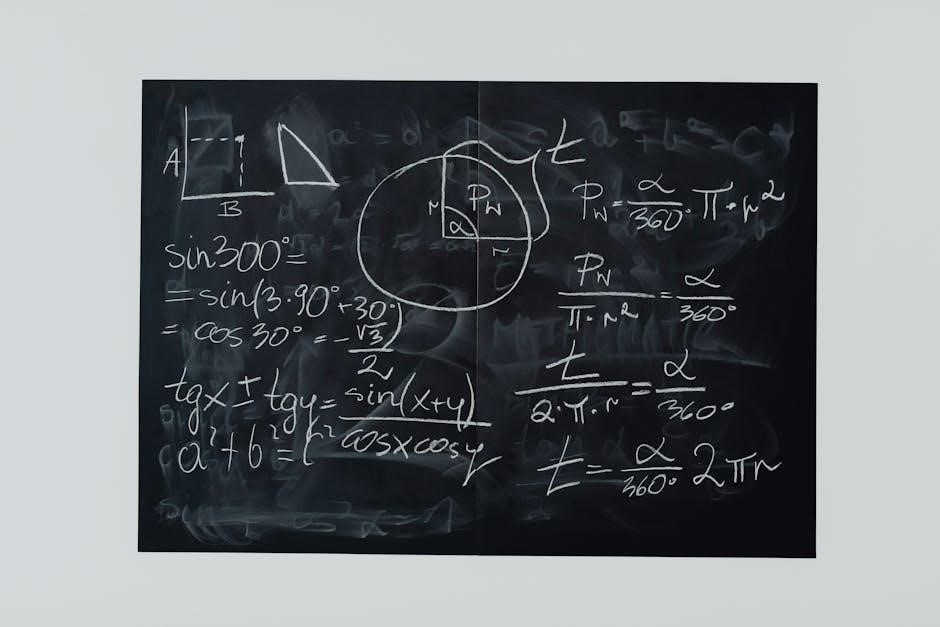
Numerous websites offer free trig values tables in PDF format, covering 0 to 360 degrees. Online calculators and interactive unit circles further enhance understanding and practical application.
Where to Find Printable Trig Tables (PDF)
Locating a comprehensive trig values table (PDF) covering 0 to 360 degrees is surprisingly accessible. Several educational websites specialize in providing printable mathematical resources. Websites like Math is Fun and RapidTables offer clearly formatted tables, often downloadable as PDF documents for offline use. These resources typically present sine, cosine, and tangent values for each degree within the specified range.
Furthermore, many university and college mathematics departments host downloadable PDF versions of trigonometric tables on their websites, intended for student use. A quick search using keywords like “printable trig table 0-360 PDF” will yield a wealth of options. When selecting a table, ensure it includes values for all quadrants and is clearly labeled for easy interpretation. Consider the table’s format – some prioritize readability, while others focus on compactness. Always verify the source’s credibility to ensure accuracy.
Downloading and printing a PDF version allows for convenient access during study sessions or exams, eliminating the need for constant internet connectivity. Remember to check the licensing terms of the PDF before distributing it.
Online Trig Calculators and Tools
While a trig values table (PDF) is useful, numerous online calculators and tools offer dynamic and interactive solutions for trigonometric calculations. Websites like Symbolab and Wolfram Alpha provide comprehensive trigonometric function evaluations, accepting angle inputs in degrees or radians. These tools often display results to multiple decimal places, exceeding the precision of a standard printed table.
Desmos, a popular graphing calculator, also supports trigonometric functions, allowing visualization of sine, cosine, and tangent curves. Many dedicated trigonometry calculators are available as web applications or mobile apps, offering features like unit circle representations and inverse trigonometric function calculations. These tools eliminate the need to manually search a PDF table for specific values.
However, understanding the underlying principles represented in a trig table remains crucial. Online tools are best used to verify calculations or explore complex scenarios, complementing rather than replacing foundational knowledge. Utilizing both a PDF table and online tools provides a robust approach to mastering trigonometry.
Understanding Unit Circle Relationship
The unit circle provides a visual and conceptual framework for understanding trigonometric values, complementing the information found in a trig values table (PDF). It’s a circle with a radius of one, centered at the origin of a coordinate plane. Any angle, measured counterclockwise from the positive x-axis, intersects the unit circle at a point (x, y).
The x-coordinate of this point represents the cosine of the angle, while the y-coordinate represents the sine. This elegantly explains why cosine is positive in the first and fourth quadrants, and sine is positive in the first and second. A PDF table lists these values, but the unit circle reveals why they change signs.
Furthermore, the unit circle clarifies the periodic nature of trigonometric functions. As you complete a full rotation (360 degrees), the values repeat. Understanding this relationship allows you to derive values beyond those directly listed in a standard trig table, fostering a deeper comprehension of trigonometry.


0 Comments